


News Category: News
Visit of Dr. Michael Artur Caves | Fulbright Specialist Programme | USIEF & Fulbright India | September 16 – October 15, 2026
19 Oct 2026
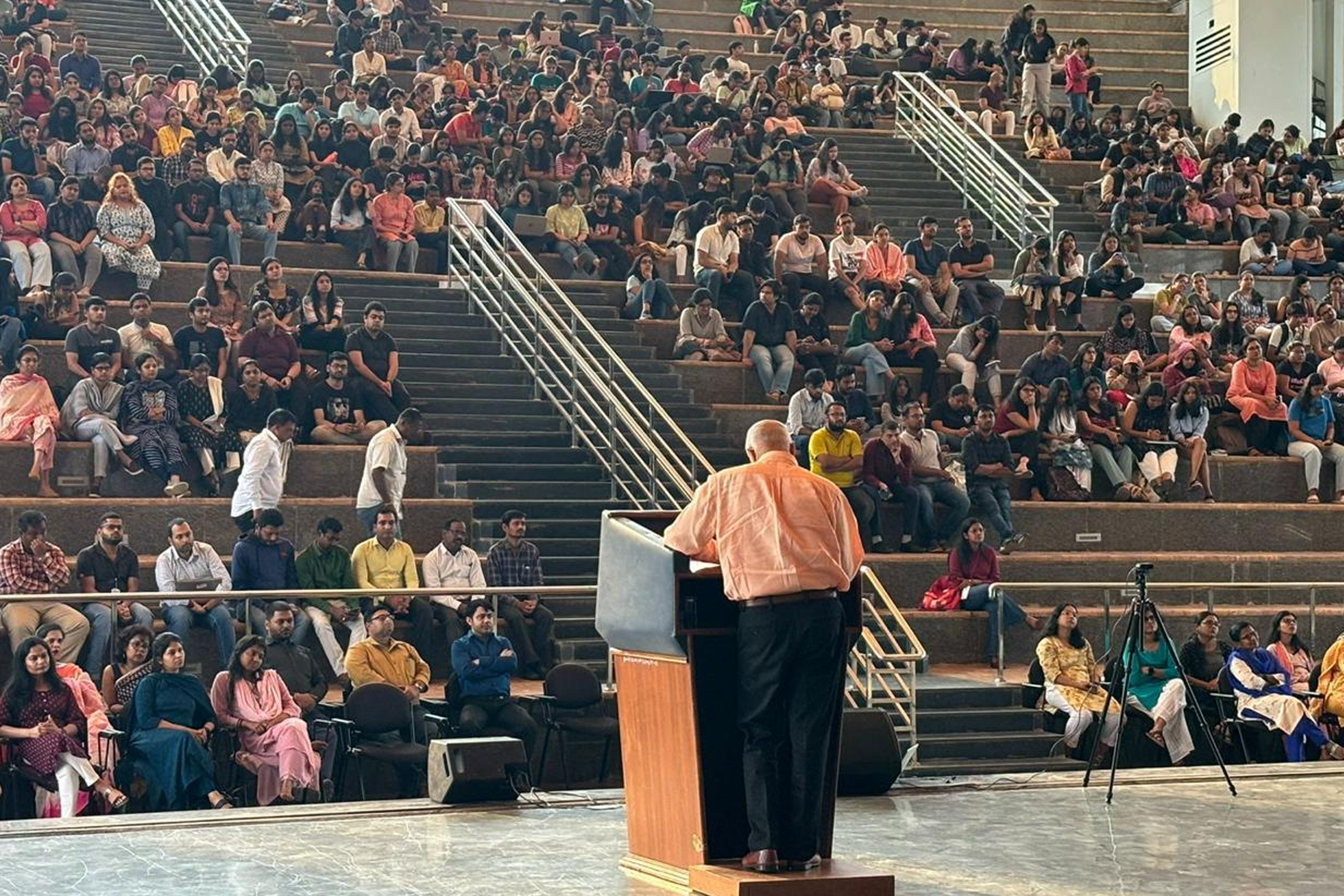
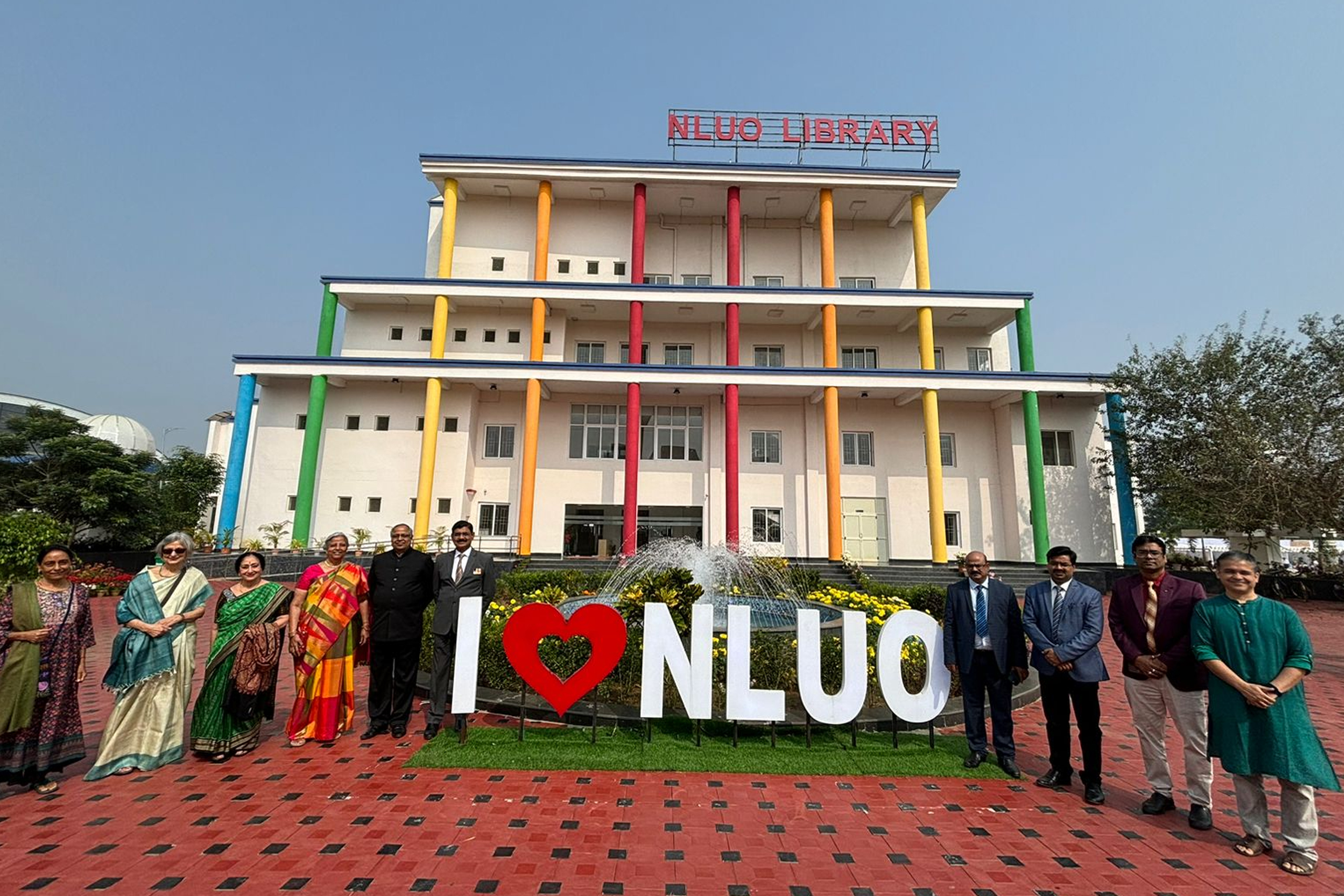
National Law University Odisha (NLUO) is delighted to announce the successful conclusion of a month-long academic engagement with Hon’ble Dr. Michael Arthur Caves, Judge of the Superior Court of California and a prestigious Fulbright Specialist.
Hosted from September 16 to October 15, 2026, this collaboration was made possible through the invaluable partnership and support of the United States-India Educational Foundation (USIEF) and Fulbright India.
During his residency, Dr. Caves drove impactful academic, research, and collaborative initiatives, within and beyond the University. He conducted dynamic lecture-cum-interactive sessions for the faculty members, Ph.D. scholars and students across all the programmes (5-year integrated law course, 3-years LL.B., B.A. (Law) and LL.M.) at NLUO and all other partnering institutions – National Law University Tripura, The Indian Law Institute, Dr. B. R. Ambedkar National Law University, KIIT School of Law, Birla Global School of Law, and Madhusudan Law University. He also delivered a high-impact special lecture for the judicial officers at the Odisha Judicial Academy.
Further, Dr. Caves actively advanced the initiatives of University’s key research centres and bodies, including NLUO Centre for Mediation and Negotiation (NLUO CMN), Centre for Criminal Justice and Human Rights (CCJHR), Centre for Disability Law and Advocacy (CDLA), Centre for Public Policy, Law and Good Governance (CPPLGG), Internal Quality Assurance Cell (IQAC) and Project KUTUMB.
We extend our profound gratitude to Dr. Caves for his outstanding mentorship, academic support, and global perspective. This partnership marks another milestone in NLUO’s commitment to fostering international legal scholarship.
THIRTEENTH CONVOCATION – 2026 National Law University, Odisha
17 Sep 2026
National Law University Odisha proudly celebrated its 13th Convocation on 12 September 2026, marking a momentous milestone in the academic journey of the graduating batch.
The ceremony was graced by Hon’ble Mr. Justice Dipankar Datta, Judge, Supreme Court of India and Visitor, NLUO; Hon’ble Mr. Justice Sheel Nagu, Judge, Supreme Court of India; Hon’ble Mr. Justice Harish Tandon, Chief Justice, High Court of Orissa, Cuttack and Chancellor, NLUO; and Prof. (Dr.) R. Venkata Rao, Vice-Chancellor, IIULER, Goa and Chief Guest, along with distinguished members of the judiciary, legal and academic fraternity.
The Convocation was led by Prof. (Dr.) K. Vidyullatha Reddy, Vice-Chancellor, NLUO, who welcomed the gathering and presented the Report of the University. Prof. (Dr.) Rangin Pallav Tripathy, Registrar, NLUO, officiated the proceedings. The convocation witnessed 246 students receiving their degrees, including 6 Ph.D. scholars, 48 LL.M. graduates and 192 undergraduate graduates. The occasion also celebrated academic excellence with 23 Gold Medals.
As the graduating students embark upon a new chapter, NLUO celebrates their accomplishments and wishes the Class of 2026 a future filled with purpose, excellence and meaningful contribution to society
2nd Kautilya Society NLUO Essay Writing Competition
12 Sep 2026
OVERVIEW OF THE INSTITUTION
National Law University Odisha, Cuttack was established by Act 4 of 2008 by the Odisha State Legislature keeping in mind an enunciated vision of advancement of learning, teaching, research, diffusion of knowledge in the field of law and catering to the needs of society by developing the professional skills of those intending to take up the professions of Advocacy, Judicial Services, Legal services, and so on. National Law University, Odisha is committed to providing an atmosphere in which academic excellence is the foremost priority for students. Along the lines of this vision, NLUO has significantly catered to the needs of the research in various legal fields by paving way for various dedicated research centers and societies. Such endeavors enable students to pursue individual interests and take part in various literary and recreational activities throughout the academic year.
The Kautilya Society NLUO is one of such initiatives of NLUO which aims at promoting study, research, and informed deliberation in the field of public policy, with an application-oriented and information-dissemination purpose.
ABOUT KAUTILYA SOCIETY NLUO
Kautilya Societies are student initiatives in universities across the country set up by Vidhi Centre for Legal Policy (“Vidhi”) with the aim to widen access to legislative drafting and analysis, and to empower young minds to explore public policy as a career path. The Kautilya Society, NLUO Chapter has been set up at National Law University Odisha, in association with Vidhi Centre for Legal Policy.
The Kautilya Society initiative envisions providing opportunities to their students for successful careers in public policy and other related fields such as development, advocacy, consultancy, campaigning, financial analysis, economics and research. The vision of the society is to provide awareness and opportunities for students to nurture their interest in public service and policy as career options with a view to becoming good citizens of India.
EVENT DETAILS
THEME: Open Theme
Introduction
The Kautilya Society is pleased to announce an Open-Theme Essay Writing Competition, and invites students to showcase their analytical and writing skills. Participants are free to choose a topic of their interest from any area of law, public policy, governance, or any other subject of contemporary relevance. The competition aims to encourage intellectual curiosity, original thought, and informed discourse by providing a platform for participants to explore issues they are passionate about. Essays will be evaluated on originality, depth of analysis, coherence, research quality, and clarity of expression. Even though the essay must revolve around Indian policy, participants may write about international events, given that a strong connection with Indian public policy must be established in the submission.
Eligibility
Students from across Universities/Colleges, duly recognised and registered in India shall be allowed to participate. Students who are not pursuing law but are interested in the subject-area are also allowed to participate.
Submission Guidelines
- Soft copies of manuscripts are to be uploaded through the submission link [Google Form] to be provided to the participants
- The google form that will be used for submission will ask for the following information. Please ensure that the same contact details are used for submission and within the submitted manuscript
- Name
- Contact Number(s)
- Submissions are to be made in the form of MS Word (2007 or 2010 or 2013)
- All submissions are to be made via a google form. (Note: write your name and co-author’s name as the filename. Example: John Davidson.docx or John Davidson, Jay David.docx)
- Manuscript word limit: 1500-2000 (excluding endnotes)
- Any uniform method of end-noting may be used.
- Font: Times New Roman. Font size: 12. Line spacing: 1.5. All text should be justified.
- Each manuscript must contain an Abstract of 50-100 words (not inclusive within the total word count)
- No separate bibliography for references is to be added. All references to be through endnotes only.
- The competition shall follow a strict plagiarism and AI policy. All articles must have a similarity index of less than 10% and 0% Articles with *% on Turnitin shall be duly read to ensure whether the piece is originally written or it has been written by an AI model.
- Manuscript should not have any indication of the Author’s identity.
Please Note:
Manuscripts not in conformity with these guidelines may be rejected at the sole discretion of the Editorial Board. The Editorial Board reserves the right to send the manuscripts back to the authors for any modification(s) at any stage, in the event of non-conformity with any of the submission guidelines. The Editorial Board may, in its absolute discretion, waive any of the above rules or amend the process. In case of any dispute or ambiguity, the decision of the Editorial Board shall be final and binding.
Procedure for checking
- First Stage: This stage shall entail a preliminary check of the article, whether it follows the prescribed formatting guidelines such as being within the word count, not breaching the plagiarism limit, is not AI-written, etc. This stage is to clerically check the article for the basics.
- Second Stage: This stage shall entail the editors to read through the articles, to assess whether the ideas are novel and original, to assess structure of the article and whether proper citations have been provided along with a grammar check. This stage shall also decide which articles are being considered for the prizes and would be forwarded to the external board of editors.
- Third Stage (or the External Panel): This shall be the final stage, where selected articles from the second stage will be forwarded to an External Panel of 3-4 members, which, on request from the Society, may be formed within Vidhi itself, to check and decide the articles which shall be selected for publication on the Website as well as the ones that will be decided as the Winners. A check-sheet shall be duly circulated to the panel as reference to be followed so that uniformity is followed in the final stage.
Manuscripts which are not rejected at the Technical Review stage shall undergo Content Review. The Content Review is conducted in two stages wherein the manuscripts which are fit for publication as is, or do not require significant changes are shortlisted for Peer Review. The manuscripts are evaluated in Content Review on the following five parameters:
- Grammar and Language
The language of the manuscript must be crisp and concise. A direct statement or argument would be preferred over an indirect one and minimum usage of passive voice is recommended. Author(s) must be familiar with the usage of a term used in the manuscript. The author(s) may be marked down for unnecessary repetition, long- winded sentences and irrelevant rhetoric.
- Structure and Logical Coherence
The manuscript must be logically sound and appropriate for the objective it seeks to achieve. Author(s) may be marked down for arguments based on incorrect premises or presumptions, the lack of a clear structure or the lack of a proper logical flow.
- Contribution to Existing Literature
If the topic of the manuscript is one which has been written about extensively in the past, the author(s) must consider what the contribution of the manuscript to the discussion is. Merely quoting and/or summarizing precedents would be inadequate. On the other hand, writing in a more innovative manner and providing a novel explanation/interpretation of a concept would be appreciated.
- Contemporary Relevance
Manuscripts are expected to include recent developments on the topic. A manuscript is considered to possess contemporary relevance when it deals with trending societal issues and legal issues that have not been given the attention they deserve. The topic may also be one that has faded from public memory but has reemerged for some reason. The relevance of the particular topic should be highlighted by the author(s) in the introduction.
- Referencing and Research
The manuscript must reflect substantial and not just superficial research. The author needs to be aware of what citation is required in the circumstances, when to cite (and when not to cite) and the relevance of that citation.
SCHEDULE
| Last date for registration | 18.09.2026 |
| Last date for submission | 28.09.2026 |
FEES
| Single Authorship | Co-Authorship | |
| NLUO Students | Rs. 200 | Rs. 300 |
| Non-NLUO Students | Rs. 300 | Rs. 500 |
REGISTRATION PROCESS
- All participants are requested to pay the registration fee in the following way:
- Visit : https://eazypay.icicibank.com
- Enter Institution Name as ‘National Law University’ and click on ‘Go’
- Fill the details.
- Email id
- Mobile No.
- Amount
- Student Name (Enter your name)
- Roll or Enrolment No. (Enter your Roll / Enrolment number for NLUO students and enter 131 for others)
- Semester (Enter your Semester number for NLUO students and enter 11 for others)
- Year
- Payment Date
- Purpose (Mention KS Essay Writing Competition)
- Once required data is filled in click on ‘Submit’ after enter the captcha and OTP.
- After the payment you will get the auto generated payment receipt.
SUBMISSION PROCESS
- Team codes will be allotted after registration.
- Registration to be done via this form by the 6th of September, 2026.
PRIZES FOR THE TOP 3 PARTICIPANTS (PRIZE POOL- 12.5K)
- Winners: 6,000/-
- Runners-up: 4,000/-
- Second Runners-up: 2,500/-
Winners will receive an internship opportunity at Vidhi Centre for Legal Policy. The top submissions will also be published on the Vidhi Blog subject to approval by External Panel.
CONTACT INFORMATION
For any queries you can mail the Society at ksociety@nluo.ac.in
Further, you can contact the persons below:
Convenor: Aryan Chowdhury (+91 8318262740)
Co-Convenor: Nidhi Rai (+91 9560392741)
Editor-in-Chief: Adrija Dey (+91 9109910526)
Livestream of 13th Convocation Ceremony of the University scheduled on 12 September, 2026
11 September 2026
4th NLUO-CLS Essay Writing Competition
14 Aug 2026
ABOUT NATIONAL LAW UNIVERSITY ODISHA
National Law University Odisha, Cuttack was established by Act 4 of 2008 by the Odisha State Legislature keeping in mind an enunciated vision of advancement of learning, teaching, research, diffusion of knowledge in the field of law and catering to the needs of society by developing the professional skills of those intending to take up the professions of Advocacy, Judicial Services, Legal services, and so on. National Law University, Odisha is committed to providing an atmosphere in which academic excellence is the foremost priority for students. Along the lines of this vision, NLUO has significantly catered to the needs of the research in various legal fields by paving way for various dedicated research centres and societies. Such endeavours enable students to pursue individual interests and take part in various literary and recreational activities throughout the academic year.
ABOUT THE CONSTITUTIONAL LAW SOCIETY
The Constitutional Law Society (CLS) is one of NLUO’s initiatives to promote study, research, and informed deliberation in constitutional law and allied subjects with a policy and application-oriented purpose. It was founded in 2018. Its mission is to facilitate discussions and research in constitutional law and related areas, focusing on practical applications. CLS NLUO provides a platform for intellectual discourse through rigorous scholarship, public lectures, seminars, independent research projects, conferences, and collaboration with like-minded individuals and institutions dedicated to constitutional studies.
COMPETITION THEMES: There shall be a total of two themes for the Essay Writing Competition.
- The Proportionality Test: Rights, Restriction, and Dissent in Constitutional India
The Indian Constitution treats liberty as a foundational value while allowing the State to impose reasonable restrictions. Contemporary practices, however, raise questions about how this balance is practiced in application. Practices such as prolonged internet suspensions, restrictions on public assembly, etc., have sparked debate over whether such restrictions satisfy the constitutional doctrine of proportionality. Participants are invited to critically examine whether the proportionality test functions as an effective safeguard against excessive State action or has become a largely formal judicial exercise.
INDICATIVE TOPICS:
- The Threshold for Bail under the UAPA and the presumption of guilt.
- Regulating Hate Speech in India: Doctrinal Gaps Between Free Expression and Public Order.
- The Special Intensive Revision of Electoral Rolls: Verification or Disenfranchisement?
- Morality and Decency: An Unreasonable Restriction on Freedom of Speech in India?
- The Right to Protest, Civil Disobedience, and the Doctrine of Constitutional Morality.
- Borrowed Constitutions: Transplant, Translation, and Transformation in Comparative Constitutionalism
Constitutions are often the product of borrowing, adaptation, and reinterpretation across jurisdictions. The constitution of India itself stands testament to this, it has drawn inspiration from the British, Irish, Canada, USA, among others. However, when a right or legal doctrine is taken out of the social and political setting where it originally developed, it inevitably changes as it adapts to a new constitutional system. Constitutional provisions may acquire different meanings when transplanted into new social and political contexts. Participants are invited to critically assess whether constitutional borrowing strengthens constitutional interpretation or undermines its legitimacy and local relevance.
INDICATIVE TOPICS:
- Judicial Borrowing: Comparative Reasoning and the Use of Foreign Precedent by the Supreme Court of India.
- Federalism Re-Imagined: Comparative Lessons from Cooperative and Competitive Federal Models.
- Constitutional Amendment Design: Rigidity, Flexibility, and Comparative Amendment Procedures.
- The use of U.S. First Amendment jurisprudence in Indian free speech cases: consistent doctrine or selective application?
- The Directive Principles of State Policy: an indigenous innovation or a transplant without context?
For the other details, kindly refer to the attached Competition Brochure.
ELIGIBILITY
- Students pursuing Five-Year/Three-Year LLB Discipline
- Students pursuing One-Year/Two-Year LLM Discipline
- Students pursuing any other undergraduate or postgraduate law degree from any recognized university
IMPORTANT DATES:
- Call for Submissions: July 30, 2026
- Last Date for Registration: August 31, 2026
- Last Date for Submission: September 20, 2026
- Declaration of Results: October 18, 2026
REGISTRATION
The registration fee is as follows for Non-NLUO participants:
- Single Authorship: ₹300
- Co-Authorship: ₹500
The registration fee is as follows for NLUO participants:
- Single Authorship: ₹250
- Co-Authorship: ₹400
After payment, you are requested to register your participation here.
For submitting your manuscript, after successful registration, please visit here.
PRIZES
The competition offers attractive prizes for the winners, runners-up, and second runners-up, including:
- Winners: ₹ 7,500 Cash Prize
- Runners Up: ₹ 5,000 Cash Prize
- Second Runners Up: ₹ 2,500 Cash Prize
The top three winning entries will also be eligible for publication in the NLUO-CLS Blog. Further, all participants will be given certificates of participation.
CONTACT INFORMATION:
Should you have any questions or require further information, please feel free to contact
- Email: editorial.cls@nluo.ac.in
- Phone: +91 85828 02714
We look forward to enthusiastic participation from your side!
Double Credit Course on “Mediation and Restorative Justice: Theory to Practice” | NLUO CMN & CCJHR | September 07 – October 13, 2026
13 Aug 2026
This is a 33-hours (30 + 3) double credit course designed to provide participants with a comprehensive understanding of Conflict Resolution, Alternative Dispute Resolution (ADR), Mediation, Restorative Justice (RJ) and Restorative Practices (RP). The course blends theory with practical tools, offering participants the skills to foster healing and accountability in various settings, including schools, families, and communities. Through a series of interactive modules, participants will explore the principles of restorative justice, its relationship with criminology and penology, restorative approaches such as victim-offender mediation, conferences and circles, and its integration into the criminal justice system, with particular emphasis on the Indian context. Practical learning is facilitated through simulation exercises and role-plays on mediation, mediator’s opening statements, restorative conferences, and restorative circles. The course also encourages participants to critically examine the differences between restorative justice and the traditional adversarial criminal justice system while developing the knowledge and skills necessary to facilitate constructive dialogue and promote peaceful dispute resolution.
For more details, please refer to the brochure.
FACULTY DEVELOPMENT PROGRAMME ON “TEACHING AND RESEARCH IN AI-DOMINATED ECOSYSTEM: CHALLENGES AND OPPORTUNITIES” | NLUO | DECEMBER 03 – 09, 2025
03 December 2025
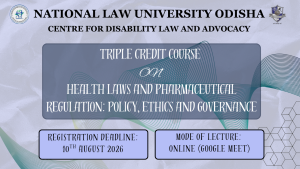
Triple Credit Course on Health Laws and Pharmaceutical Regulation: Policy, Ethics, and Governance
27 July 2026
Legal and Policy Gaps in Implementing WHO FCTC and MPOWER in India
08 June 2026
The report titled Legal and Policy Gaps in Implementing WHO FCTC and MPOWER in India, prepared by Prof. (Dr.) Yogesh Pratap Singh, Vice Chancellor, National Law University, Tripura, was submitted to the National Law University Odisha as a part of the Project on ‘Supporting Stronger and Evidence-Based Tobacco Control Initiatives through Capacity Building and Strengthening Laws, Policies and Institutional Mechanisms with Multi-Stakeholder Engagement towards Tobacco-free India’, under the guidance of Dr. Amit Yadav, Deputy Director, Vital Strategies, New Delhi.
The report provides a comprehensive analysis of India’s position in implementing WHO’s MPOWER tobacco control measures, identifies key policy gaps, and offers recommendations to strengthen tobacco regulation. The report further presents strategies for achieving the highest MPOWER compliance, which can help the country enhance its tobacco control measures.
NLU Odisha and NLU Tripura hope that this report serves as a valuable resource and contributes towards the ongoing efforts to strengthen tobacco control in India.
Call for submissions: Journal on the Rights of the Child of National Law University Odisha Volume VII, Issue II
30 Jun 2026
