
News Category: News
35th Informal Discussion Group Session with Dr. E. A. S. Sarma
16 Mar 2026
Theme-Governance, Law and Public Interest
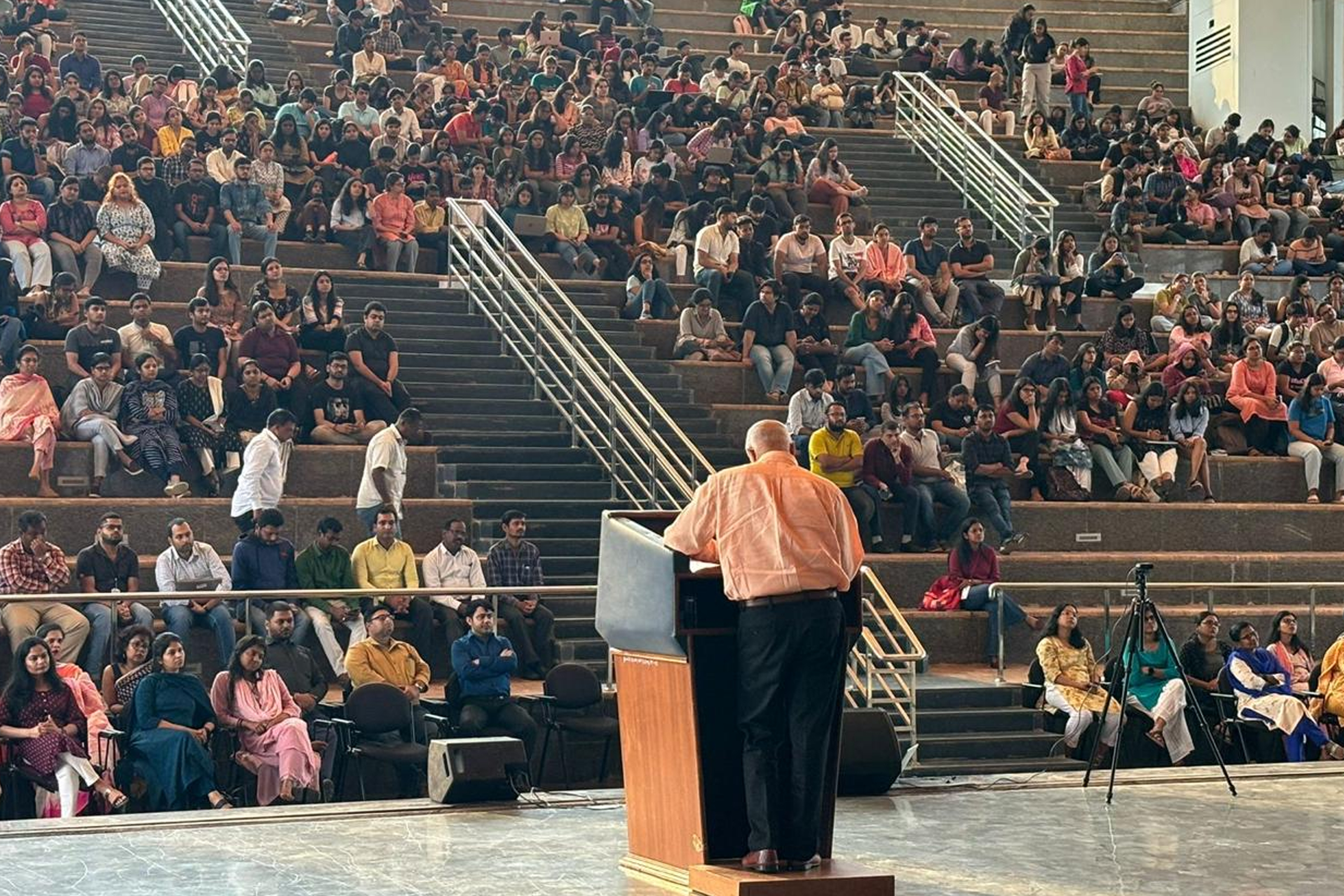
On 10 March 2026, the Informal Discussion Group of NLU, Odisha, hosted a session on “Governance, Law and Public Interest” featuring noted public policy commentator and former civil servant Dr. E. A. S. Sarma. A former member of the Indian Administrative Service (1965–2000), Dr. Sarma served as Secretary to the Government of India in the Ministries of Power and Finance and later as Principal Adviser (Energy) to the Planning Commission.
The discussion began with a brief exchange on the idea of development, before expanding into a broader conversation on governance, public accountability, and civic engagement. Drawing from his post-retirement public interest work, Dr. Sarma spoke about issues ranging from environmental advocacy in the Vedanta mining controversy in the Niyamgiri Hills to the human rights concerns surrounding the Salwa Judum case. He also emphasised the role of informed public discourse and litigation in strengthening democratic institutions and protecting public interest.
NLUO Vice Chancellor Prof. Ved Kumari Honoured by BNI Achievers on International Women’s Day
11 Mar 2026
National Law University Odisha (NLUO) is exceptionally proud to announce that our esteemed Vice Chancellor, Prof. (Dr.) Ved Kumari, has been felicitated by BNI Achievers, Cuttack (part of BNI Greater Odisha) in recognition of International Women’s Day.
The event was specially organized to celebrate and honour dynamic women who are making a profound, positive impact on society through their leadership and community service.
During the ceremony, Prof. Kumari was recognized for her inspiring leadership, her remarkable contributions to the advancement of legal education, and her unwavering commitment to empowering society through knowledge. Her extensive career and visionary approach to academic excellence were highlighted as key drivers in her selection for this honour.
This recognition by BNI Achievers serves as a testament to Prof. Kumari’s exceptional leadership and the broader impact of her work beyond the university campus. Her continued dedication serves as a beacon of inspiration for students, faculty, and the entire NLUO community.
The university fraternity extends its most heartfelt congratulations to Prof. (Dr.) Ved Kumari on this highly well-deserved recognition, celebrating yet another proud milestone for National Law University Odisha.
NLUO Faculty Dr. Tanwi Shams selected as Mentor for Prestigious NUS Law Alumni Mentor Programme.
07 Mar 2026
National Law University Odisha (NLUO) is proud to announce that Dr. Tanwi Shams, Assistant Professor of Law, has been selected as a Mentor for the Law Alumni Mentor Programme (LAMP) at the National University of Singapore (NUS) for the 2026–27 academic year.
This appointment marks a significant international milestone, reflecting the global recognition of NLUO’s faculty expertise and the university’s rising academic standing.
Dr. Shams, an esteemed alumna of NUS Law ( 2015-16) returns to her alma mater to guide the next generation of legal professionals. Her academic pedigree is distinguished by a PhD in Law and an LLM in IP & Technology Law from NUS. This transition—from a successful student at a world-class institution to a mentor for its future graduates—underscores the high caliber of NLUO faculty and their profound impact on the global stage.
As a LAMP Mentor, Dr. Shams will bridge the gap between academic study and professional practice by:
- Helping current NUS Law students navigate complex academic and career trajectories.
- Offering unique perspectives from her professional journey and her deep expertise within the Indian legal system.
- Fostering international connections between students and established legal practitioners.
Child protection needs to be proactive, not just reactive, underlines Hon’ble Justice Savitri Ratho of Orissa High Court at the Child Protection Mentorship Programme Valedictory Function
27 Feb 2026
The Centre for Child Rights (CCR) at the National Law University Odisha (NLUO), supported by UNICEF, organized a valedictory function for the Child Protection Mentorship Program (CPMP) on 21st July 2025 at NLUO, Cuttack. Hon’ble Miss Justice Savitri Ratho, Judge of the Orissa High Court and Chairperson of the Juvenile Justice Committee (JJC), Smt. Manasmita Khuntia, Hon’ble Member, Odisha State Commission for Protection of Child Rights (OSCPCR), Mr Manna Biswas, Child Protection Specialist at UNICEF Odisha, Prof Ved Kumari, Vice Chancellor of NLUO and Patron-in-chief of CCR, and Prof Biraj Swain, Chief Minister’s Chair Professor and Director, CCR-NLUO distributed the certificates to the graduating mentees.
A total of 63 frontline workers in the child protection sector received their graduation certificates from the CPMP out of the 100 shortlisted participants. The cohort reflected a young and diverse background, comprising 46% women with an average age of 35 years. Bringing together experience from across sectors, 33% of the participants represent different government agencies, while 67% came from civil society organisations. Professionally, 54% have a background in social work, while 46% includes lawyers and child psychologists. With representation spanning 16 districts of Odisha, the programme demonstrated a significant statewide outreach. Additionally, the participants are working in diverse settings, with 36% in rural areas, 36% in urban areas, and the remaining working across both settings.
CCR is the oldest centre at NLUO, second oldest CCR in any NLU in India and the only Chair Professorship on Child Rights in India (law and non-law Universities included). It is committed to integrating the entire spectrum of child rights in teaching, research, advocacy and interventions and model building. Over the years, the centre has established itself as a leading stake-holder in all child rights’ issues such as juvenile justice, child participation, alternative care, child-friendly policing, child safety and survival, and the economic, social, and cultural rights of children and families and the determinant sectors.
Conceived as a skill upgradation initiative, the CPMP offered by CCR aims to empower a new generation of child protection practitioners by equipping them with knowledge, practical tools, skills, attitude and ethical perspective to effectively respond to the complex challenges that children across the State are presently facing. Over the course of 32 online sessions, 15 mentors shared their experiences and offered practical insights through a participatory learning process. Mr Ankit Kumar Keshri, UNICEF supported consultant with NLUO-CCR alongwith Dr Rashmi Rekha Baug, Assistant Prof of Law and Co-Director, Centre for Women and Law, Director, Centre for Poverty and Access to Justice, NLUO, led the course curation and execution for the inaugural batch, setting the template for the future batches to come.
Mr Keshri also made the efforts to convert the mentorship programme into credit-course compliant, academically bench-marked modules and processed the feedback for future improvement of the programme.
The graduates from the CPMP are expected to take lead in implementing government schemes, strengthen NGO interventions, work as statutory body members like Juvenile Justice Boards (JJB) and Child Welfare Committees (CWC), and ultimately serve as watchdogs of child rights within communities across the State of Odisha.
The valedictory function, held in a hybrid format, witnessed the presence of dignitaries from the judiciary, academia, law enforcement, statutory bodies, civil society, and development partners. In total 109 participants joined the function — 89 in person and 20 online. Besides the key dignitaries, other distinguished guests who attended the function included: Shri Aurobindo Pattanaik, Member Secretary, Odisha State Legal Services Authority; Mohammed Habibur Raheman, Law Officer, OSCPCR; Mr Om Prakash Panda, Legal Consultant with OSCPCR and Dr Satyajit Mohanty, former DGP Odisha Police, former Chairperson Odisha Public Service Commission (OPSC) and also an Adjunct Professor of Law at NLUO. Mentors such as Dr Kalpana Purushothaman, Trauma-informed Counseling Psychologist, Author, and Child Rights Advocate, Mr Sonykutty George, Child Protection Specialist, UNICEF Hyderabad; Mr Govind Beniwal, Child Protection Officer, UNICEF Madhya Pradesh and Mr Ghasiram Panda, Child Protection Consultant, UNICEF Odisha also joined digitally.
Prof Biraj Swain, Chief Minister’s Chair Professor and Director, CCR-NLUO spoke about CCR, the flagship interventions of the year gone by and the CPMP to set the context for the valedictory function.
While delivering the welcome address, Prof Ved Kumari, Vice Chancellor of NLUO and Patron-in-chief of CCR, noted that the most eminent child rights experts of India delivered the sessions covering the entire spectrum of child protection and child rights.
Mr Manna Biswas, Child Protection Specialist, UNICEF Odisha, emphasized that the real success of CPMP would be when the graduates will take up key roles within statutory child protection bodies like the CWC and JJB. He also emphasized the need for the government to take ownership of programmes like CPMP to ensure their institutionalization and long-term sustainability.
This was followed by a brief interactive discussion where both mentees and mentors were encouraged to share their experience.
Dr Satyajit Mohanty, Retired IPS, former DGP of Odisha, former Chairperson of the OPSC, and Adjunct Professor of Law at NLUO, shared his perspectives on child-friendly police stations and recommended that CPMP like programmes should also be designed specifically for police personnel.
Smt. Manasmita Khuntia, Hon’ble Member, OSCPCR, addressed the gathering on OSCPCR’s priorities in child protection. She underscored the urgent need to focus on peripheries of the State, where child protection concerns like child marriage, teenage pregnancy, school dropout are spiking and declining sex ratio remain more prominent. She emphasised that initiatives like CPMP are a step in the right direction to effectively address these pressing challenges.
The Presidential Address was delivered by Hon’ble Miss Justice Savitri Ratho. In her address, she underscored that child protection efforts must move beyond reactive responses and place stronger emphasis on prevention, early identification of risks, and community-based interventions. She observed that frontline child protection responders serve as the backbone of the system, playing a pivotal role in safeguarding children and ensuring the protection of their rights at every stage. Encouraging participants to meaningfully apply the knowledge and skills acquired through the mentorship programme, she called for sustained commitment towards strengthening child protection mechanisms across the State. Commending CCR-NLUO and UNICEF for successfully executing CPMP, Justice Ratho described the initiative as a significant step towards empowering frontline child protection cadres and reinforcing institutional capacity.
The mentorship certificates were distributed by dignitaries. The function concluded with a “Vote of Thanks” proposed by Mr Vijay Bhaskar, Assistant Professor of Law and Co-Director, Centre for Child Rights, Centre for Tribal Studies & Pro Bono Club and Associate Coordinator, Project Kutumb, along with Ms Akanksha Yadav, Assistant Professor of Law and Co-Director, Centre for Child Rights, NLUO. Other core members of the CCR present at the function and running the function were, Dr Swagatika Samal, Dr Pradipta Sarangi, Mr Amulya Swain and Mr T Swaraaj. The student members of CCR who have been selected through an open competitive process were Suraj, Kashish, Sushant, Akshat, Amit, Abhinandan, Jyotirmay, Subhadra, Shehnaaz and Ashwani. The valedictory function marked the formal conclusion of the four-month online mentorship programme for the 2025 batch.
For more information:
Mr Ankit Keshri: 9475133988
Dr Swagatika Samal: 8249012917
National Law University Odisha (NLUO), Cuttack Municipal Corporation (CMC) and District Child Protection Unit (DCPU) – Cuttack organize Special Aadhaar Enrolment Camp for Children of Cuttack Urban Settlements of Brajabiharipur, Balmiki Nagar and Baba Tilkanagar
27 Feb 2026
Cuttack, Odisha | February 26, 2026 — In an important initiative to advance child rights and social inclusion, the Centre for Child Rights (CCR) of National Law University Odisha (NLUO) and the University’s flagship community outreach initiative – Project KUTUMB, jointly organised a Special Aadhaar Enrolment Camp on 25th February 2026 at Balmiki Nagar Community Centre, CDA – 13 for over 50 children from Balmiki Nagar, Brajabiharipur, and Baba Tilkanagar urban settlements of Ward No. 3, Cuttack Municipal Corporation (CMC).
The flag off of the Special Aadhar Camp was done in the presence of the Commissioner, Cuttack Municipal Corporation (CMC), Ms. Kirandeep Kaur Sahota, NLUO Vice Chancellor Professor Ved Kumari, Chief Minister’s Chair Professor cum Director, Centre for Child Rights – NLUO, Prof Biraj Swain, Additional District Education Officer, Cuttack, Smt. Abhijita Bhaskar, Social Worker – District Child Protection Unit, Cuttack, Shri Congress Rout, and Corporator of Ward No. 3 – CMC, Shri Pradeep Rout. The initiative was led by Dr Swagatika Samal from CCR – NLUO and Dr Akshay Verma, Coordinator – Project KUTUMB and supported by Mr Durbadala Mantry, Mr M Vijay Bhaskar, Dr Pradipta Kumar Sarangi, Mr Ankit Kumar Keshri and Mr Amulya Kumar Swain of CCR-NLUO. The Camp is running over 25th and 26th February 2026.
The Camp is part of NLUO’s commitment to creating Child-Friendly Communities per NITI Ayog mandate and the Sustainable Development Goals mandate, and it marks a milestone in Project KUTUMB’s mission to ensure social inclusion of the vulnerable children.
Project Kutumb, launched in August 2022, is NLUO’s flagship outreach programme, implemented with the shared leadership of the CCR. It seeks to transform the urban settlements – Brajabiharipur (Upara Sahi and Tala Sahi), Baba Tilkanagar, and Balmiki Nagar into aspirational communities with active citizenship and responsive state mechanisms. The project takes a rights-based and community-driven approach by empowering families, children, and local institutions to take an active role in child welfare and protection. Through a combination of awareness-building, capacity enhancement, needs assessment, and vulnerability mapping, Project KUTUMB, aims to establish sustainable, locally lead child protection systems with long-term impact.
Founded in 2015, the Centre for Child Rights (CCR) is the oldest research, teaching and advocacy center at NLUO. It is also the second oldest CCR in any NLU in India and the only Chair Professorship on Child Rights in India (Law or non-Law Universities included), thanks to the efforts of the Vice Chancellor Prof Ved Kumari. The CCR is committed to advancing child rights through teaching, legal research, policy advocacy, training and community engagement. As one of the key actors of Project KUTUMB, CCR has conducted extensive vulnerability mapping and needs assessments in the adopted settlements to ensure that interventions are data-driven and need-sensitive, keep the best interests of the children front and centre. This is per the NITI Ayog mandated indicators.
Smt. Abhijita Bhaskar, Additional District Education Officer, Cuttack, while addressing the gathering, stressed that Aadhaar enrolment strengthens service delivery and that’s why one should be very careful about the kind of information – specifically a functional mobile number- providing during Aadhar enrolment process.
Addressing the audience on the genesis and vision of Project KUTUMB, Prof. Ved Kumari, Vice Chancellor of NLUO and Patron-in-Chief of CCR-NLUO, who conceptualized Project KUTUMB, noted that legal identity is a gateway to dignity, citizenship, and equal opportunity for children. Substantive progress in child protection is possible only when there is consistent collaboration between community and the state instruments and children have a voice and agency in shaping their own and their community’s futures. She further added that “NLUO is not just an institution to churn out legal professionals, NLUO is also committed to the agenda of justice and enabling the under-privileged children and communities in the neighbourhood for better lives and life-chances, which is a core ambition of Project KUTUMB and NLUO. Children need to be encouraged, and it would make me very happy to see some of you enroll in the NLUO one day.”
The Keynote Address was delivered by Ms. Kirandeep Kaur Sahota, Commissioner, Cuttack Municipal Corporation, who formally flagged off the Special Aadhaar Camp by enrolling two children from the communities. She emphasised that inclusive urban governance requires proactive outreach to vulnerable populations and lauded NLUO’s sustained commitment to community engagement.
For further information, please contact:
Dr. Swagatika Samal: swagatika@nluo.ac.in Mob: 9439872656
Mr. Dubadala Mantry: d.mantry@nluo.ac.in Mob: 9692004909
Centre for Child Rights (CCR) and Project KUTUMB
National Law University Odisha (NLUO)
Posting of Competition Details for External Participation
12 Feb 2026
The Centre for Film Studies, NLUO is organising an Alternate Ending Competition inviting participants to creatively reimagine the ending of the 2018 film “Andhadhun”. Participants are required to submit a written screenplay in accordance with the formatting guidelines provided in the brochure. The competition is open for registrations until 7th March 2026, with the top three submissions being awarded cash prizes.
The Link for Registration: Link
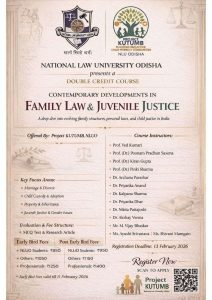
DOUBLE CREDIT COURSE ON CONTEMPORARY DEVELOPMENTS IN FAMILY LAW AND JUVENILE JUSTICE CONTEMPORARY DEVELOPMENTS IN FAMILY LAW AND JUVENILE JUSTICE
10 Feb 2026
ABOUT PROJECT KUTUMB
Project KUTUMB is a flagship outreach programme by the National Law University Odisha, launched in 2022, that aims to transform adopted communities into child-friendly settlements by improving access to education, health, and legal awareness. The project uses a rights-based and community-driven approach, focusing on strengthening local institutions and empowering families to create sustainable, locally-led child protection systems. It works in areas like Braja Beharipur, Baba Tilkanagar, and Valmiki Nagar to implement initiatives aligned with India’s Mission Vatsalya mandate.
ABOUT THE COURSE
The Double Credit Course titled “Contemporary Developments in Family Law and Juvenile Justice” under Project KUTUMB aims to provide a comprehensive understanding of the evolving landscape of family law and juvenile justice in India, with particular emphasis on modern reforms, judicial interpretations, and socio-legal challenges emerging from non-traditional familial relationships. The course seeks to bridge theoretical perspectives with contemporary realities, analysing legislative amendments, landmark judgments, and policy measures that continue to redefine the framework of Indian family law and juvenile justice. By the end of the course, participants will have developed a nuanced appreciation of how Indian family law is adapting to modern social realities while balancing constitutional values, individual rights, and societal welfare. This course is ideal for law students, researchers, academicians and practitioners seeking to deepen their understanding of family law and juvenile justice in the contemporary context and to engage meaningfully with ongoing legal and social transformations.
RESOURCE PERSONS
- Ved Kumari, Vice-Chancellor and Professor of Law, NLUO
- (Dr.) Poonam Pradhan Saxena, Former Vice-Chancellor and Professor of Law, NLUJ
- (Dr.) Kiran Gupta, Former Professor In-charge and Professor of Law, Law Centre – II, Faculty of Law, University of Delhi
- (Dr.) Pinki Sharma, Professor of Law, Law Centre – II, Faculty of Law, University of Delhi
- Archana Parashar, Honorary Associate Professor, Macquarie Law School, Macquarie University, Australia
- Priyanka Anand, Associate Professor of Law, NLUO
- Kalpna Sharma, Assistant Professor of Law (Selection Grade), Law Centre – II, Faculty of Law, University of Delhi
- Priyanka Dhar, Assistant Professor of Law, HNLU
- Nikita Pattajoshi, Assistant Professor of Law, NLUO
- Akshay Verma, Assistant Professor of Law, NLUO
- M Vijay Bhaskar, Assistant Professor of Law, NLUO
- Ayushi Srivastava, Assistant Professor of Law, NLUO
- Shivani Mamgain, Researcher (Queer Legal Theory), NALSAR University of Law
COURSE EVALUATION
- Component A: Multiple Choice Questions (MCQs) – 50 marks
- Component B: Submission of Short Article (Research Project) – 40 marks
- Component C: Class Participation – 10 marks
ELIGIBILITY
This course is open to all interested participants; however, it would be highly beneficial for:
- 5-year or 3-year law course students
- Postgraduate law course students
- Research Scholars
- Academicians
- Advocates
- Other Professionals
FEE STRUCTURE
- For NLUO Students: INR 950/- [Early Bird – INR 850/-]
- For Non-NLUO Students: INR 1150/- [Early Bird – INR 1,050/-]
- For Professionals: INR 1400/- [Early Bird – INR 1,250/-]
Early Bird offer valid till 11th of February 2026 (Wednesday), 11:59 p.m. (IST).
PAYMENT DETAILS
- Visit: https://eazypay.icicibank.com/homePage
- Enter Institution Name as ‘National Law University’ and click on ‘Go’
- Fill in the following details
- Email id
- Mobile No.
- Amount
- Student Name (Enter your name)
- Roll or Enrolment No. (Enter your Roll /Enrolment number for NLUO student and enter 131 for others)
- Semester (Enter your Semester number for NLUO student and enter 11 for others)
- Enter the Year
- Enter the Payment Date
- Enter the Purpose (Mention “Double Credit Course on Contemporary Developments in Family Law and Juvenile Justice”)
- Once required data is filled in click on ‘Submit’ after entering the captcha and OTP.
After the payment you will get the auto generated payment receipt which must be uploaded in the registration form.
NLUO made a presentation before the Joint Parliamentary Committee on 22 January 2026
29 Jan 2026
Prof. (Dr.) Rangin Pallav Tripathy, Registrar, National Law University Odisha, along with Dr. Rishika Khare, Assistant Professor of Law, National Law University Odisha, made a presentation before the Joint Parliamentary Committee on 22 January 2026 on three significant legislative proposals.
They were invited to present their views on the key provisions of the Constitution (One Hundred and Thirtieth Amendment) Bill, 2025; the Jammu and Kashmir Reorganisation (Amendment) Bill, 2025; and the Government of Union Territories (Amendment) Bill, 2025. During the presentation, they analysed and commented on several important clauses and constitutional implications arising from the proposed amendments.
Introduced on the final day of the Monsoon Session on 20 August 2025, the Bills propose the automatic removal of the Prime Minister, Chief Ministers, and Ministers if they are arrested for a period of thirty days in connection with serious charges.
The Government of India has constituted a Joint Parliamentary Committee (JPC) to examine the three Bills. The Committee comprises 31 Members, including 21 Members from the Lok Sabha and 10 Members from the Rajya Sabha, and is chaired by Ms. Aparajita Sarangi, Member of Parliament (Lok Sabha).
NLUO Presents IEC Videos on Tobacco Free Educational Institution (ToFEI) Guidelines
29 Jan 2026
National Law University Odisha, as part of its Project on Tobacco Control Initiatives, has developed Information, Education and Communication (IEC) videos on Tobacco Free Educational Institution (ToFEI) Guidelines in English, Hindi and Odia. These videos aim to guide the educational institutions in fulfilling the mandates of the ToFEI Guidelines, enabling them to become tobacco-free and provide a healthy environment for students and staff.
To expand the outreach and promote awareness nationwide, the videos are proposed to be translated into more than eight Indian languages.
ToFEI Guidelines Awareness Video – English
ToFEI Guidelines Awareness Video – Hindi
ToFEI Guidelines Awareness Video – Odia
For more information, contact ptci@nluo.ac.in
Triple credit Course on “Law , Technology and Vulnerability”
15 Jan 2026
