News Category: Upcoming Events
Faculty Development Programme
3-9th December,2025
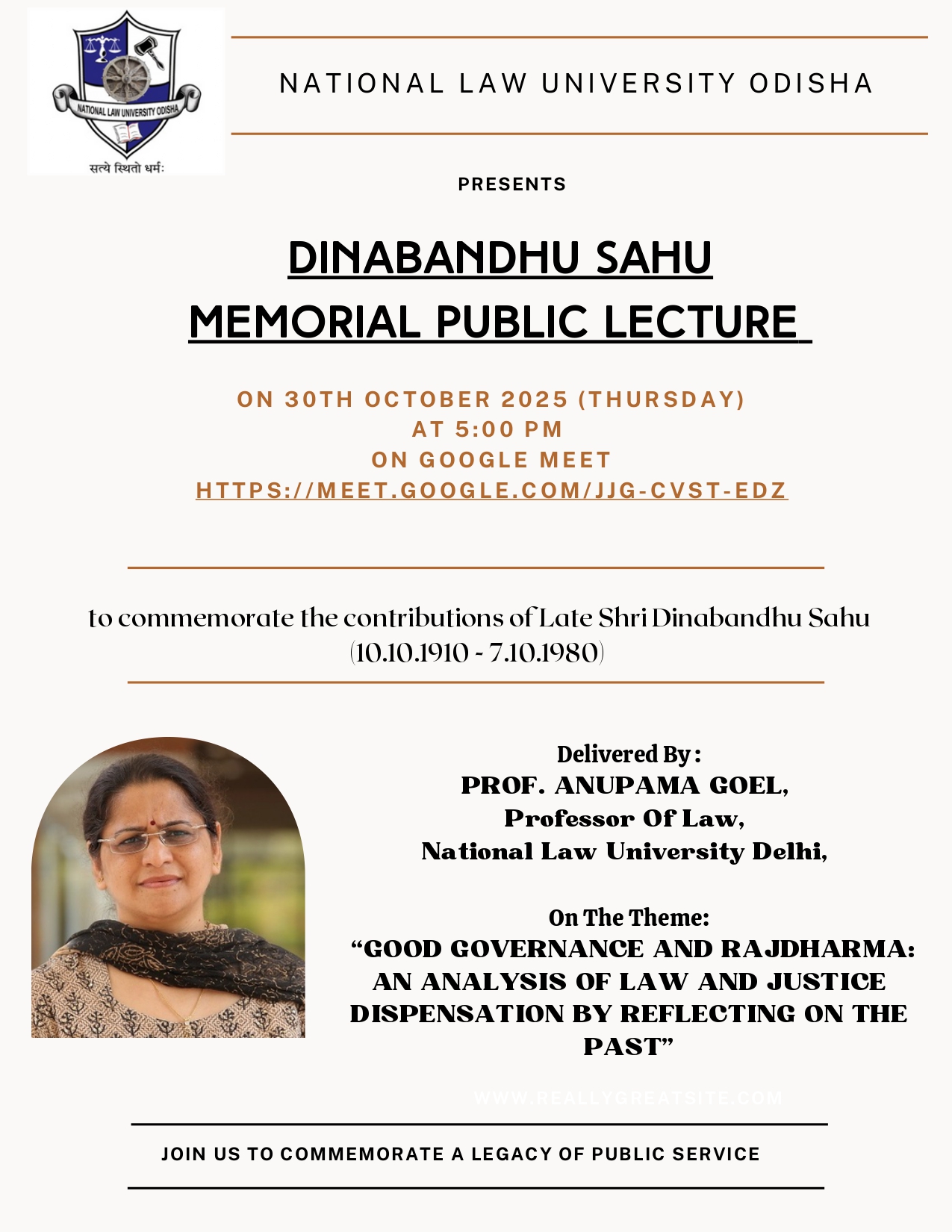
Dinabandhu Sahu Memorial Public Lecture on Good Governance and Rajdharma: An Analysis of Law and Justice Dispensation by Reflecting on the Past.
30th October 2025
About the Public Lecture
National Law University Odisha is organising the Dinabandhu Sahu Memorial Public Lecture to commemorate the invaluable contributions of Late Shri Dinabandhu Sahu in the public sphere both within and outside the Government dedicated to the social, educational, and economic advancement of the people and the overall development of the nation.
The lecture will be delivered by Prof. Anupama Goel, Professor of Law, National Law University Delhi, on the theme: “Good Governance and Rajdharma: An Analysis of Law and Justice Dispensation by Reflecting on the Past.”
Details of the Event:
Date: Thursday, 30th October 2025
Time: 5:00 PM
Mode: https://meet.google.com/jjg-cvst-edz
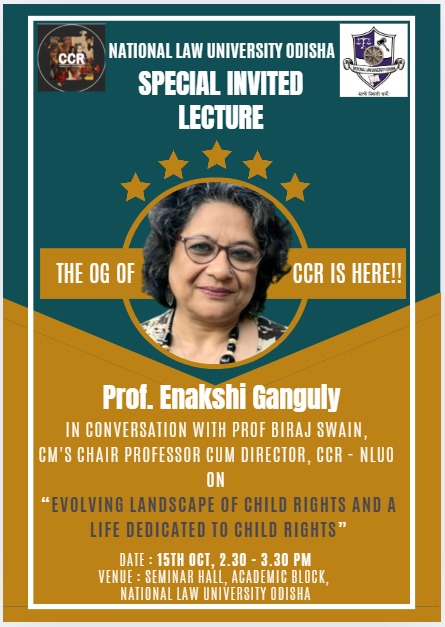
Special Invited Lecture by Prof Enakshi Ganguly on “Evolving Landscape of Child Rights and a Life Dedicated to Child Rights”
15th, Oct 2025
About the Special Invited Lecture:
Centre for Child Rights (CCR) – National Law University Odisha (NLUO) is honoured to host a special invited lecture titled “Evolving Landscape of Child Rights and a Life Dedicated to Child Rights” by Prof Enakshi Ganguly, the OG of CCR-NLUO and globally renowned Human Rights and Child Rights Champion, Executive Director of Housing and Land Rights Network, Co-founder and former Executive Director, HAQ Centre for Child Rights and Honorary Professor at NLUO. In this interactive session, she will be in conversation with Prof Biraj Swain, CM’s Chair Professor cum Director, Centre for Child Rights (CCR) – NLUO, reflecting on her lifelong journey in advancing justice and protection for children. The event aims to inspire students, researchers and participants to engage with emerging child rights challenges and innovations.
UNRAVELLING THE FIRST ISSUE OF CCR’S FLAGSHIP JOURNAL POST-INDEXATION
15th, Oct 2025
About the Event
The Centre for Child Rights (CCR), National Law University Odisha, with the support of Child Rights and You (CRY), is unravelling the first issue of the Centre’s flagship journal – Journal on the Rights of the Child of National Law University Odisha, post-indexation on 15th October 2025. The centre is also releasing its Bi-monthly Newsletter in the event that is completely designed and managed by CCR Students’ Body. The event will feature eminent dignitaries including Hon’ble Justice Savitri Ratho, Judge – Orissa High Court and Chairperson – JJC, Orissa High Court, Prof Enakshi Ganguly, globally renowned Human Rights and Child Rights Champion, Executive Director of Housing and Land Rights Network, Co-founder cum former Executive Director, HAQ Centre for Child Rights and Honorary Professor at NLUO, Ms Puja Marwaha, Chief Executive Officer, Child Rights and You (CRY) along with child rights champions from UNICEF and others.
venue
Seminar Hall, 2nd Floor, Academic Block
Time
5.00 PM to 7.30 PM
Lecture-cum-Interactive Series with Dr. Suryaprakash Mishra | Inaugural Lecture | 10th October
10th Oct 2025
Queering the Law: Looking Beyond Supriyo
23 Sep 2025
INTRODUCTION
The case of Supriyo v. Union of India is a landmark legal proceeding central to the discourse on equality in India. It is fundamentally concerned with the future of LGBTQIA+ rights within the nation. The case was initiated by members of the queer community who brought a writ petition before the Supreme Court under Article 32 of the Constitution of India, seeking the enforcement of their fundamental rights. They sought not only the legal recognition of marriage for same-sex couples by challenging existing statutes; but also a range of directions to the government and police to protect them from discrimination, harassment, and violence, and to secure benefits associated with unions, such as adoption, financial entitlements, and healthcare decisions. This legal battle represents a critical juncture in the ongoing journey towards securing comprehensive rights and recognition of the LGBTQIA+ community.
AIM OF THE EVENT
The primary aim of the guest lecture, “Queering the law: looking beyond Supriyo,” is to facilitate a nuanced discussion on the future of LGBTQIA+ rights in India following the Supreme Court’s landmark judgment in Supriyo v. Union of India. While the verdict disappointed many, by unanimously holding that there is no fundamental right to marry under the Constitution, and ruling against a right to civil unions via a 3:2 majority, the judgment is not the end of the conversation.
This event seeks to move beyond the headline verdict to critically analyse the significant acknowledgements and directives within the ruling. The lecture will explore the court’s recognition of systemic discrimination against the queer community and the possibility of a entering into a “union,” distinct from marriage. Furthermore, it will delve into the concrete, positive directions issued by the court, such as those for police sensitisation, the creation of safe houses, and a ban on conversion therapy.
A key focus will be the path forward. The discussion will scrutinise the role of the high-powered committee proposed by the government to examine entitlements for queer couples and consider whether this is an adequate substitute for full legal recognition. Ultimately, the event aims to foster a strategic dialogue on the future of this movement, looking towards legislative reform and further advocacy in the wake of the Supriyo decision.
ABOUT OUR GUEST LECTURER
The lecture will be delivered by Ms. Jwalika Balaji, a Research Fellow in the Research Director’s Office at the Vidhi Centre for Legal Policy, Delhi. She holds a Bachelor of Civil Law (LLM-equivalent) degree from the University of Oxford and a BA. LL.B. (Hons) from the National Law School of India University, Bangalore. Her areas of interest include family law, equality and anti-discrimination law, and human rights, with a special emphasis on gender and sexuality. She is on the Board of Directors at OutLawed India, a not-for-profit organisation working to improve access to law and justice. At Vidhi, she has been providing legislative drafting assistance to various Ministries, Departments, and Authorities of the Central Government and various State Governments. She has worked closely on Vidhi’s brief on the subject of the guest lecture and helped in the release of the final consultation papers and chapters, collaborating with the Keshav Suri Foundation.
OVERVIEW OF THE INSTITUTION
National Law University Odisha, Cuttack was established by Act 4 of 2008 by the Odisha State Legislature keeping in mind an enunciated vision of advancement of learning, teaching, research, diffusion of knowledge in the field of law and catering to the needs of society by developing the professional skills of those intending to take up the professions of Advocacy, Judicial Services, Legal services, and so on. National Law University, Odisha is committed to providing an atmosphere in which academic excellence is the foremost priority for students. Along the lines of this vision, NLUO has significantly catered to the needs of the research in various legal fields by paving way for various dedicated research centres and societies.
Two-Day National Workshop on “12 Years of NFSA: Reflecting on Implementation, Exclusion and the Future of Food Rights”
20th September 2025
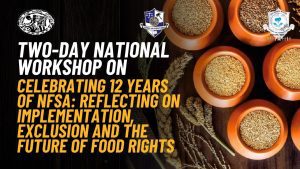
The Centre for Tribal Studies, National Law University Odisha (NLUO), in collaboration with the Jal Shakti Board, NLUO and the Right to Food Campaign, is organising a Two-Day National Workshop on “12 Years of NFSA: Reflecting on Implementation, Exclusion and the Future of Food Rights” on 20th and 21st September 2025 (Saturday and Sunday). The event will be conducted in hybrid mode, with participants joining both at the NLUO campus in Cuttack and online via digital platforms.
The enactment of the National Food Security Act (NFSA), 2013 was a watershed moment in India’s social welfare history. It legally recognised food as an entitlement, extending subsidised food grains to nearly 75% of the rural population and 50% of the urban population. Over the past twelve years, the NFSA has shaped the country’s food security landscape, impacting millions of lives through schemes such as the Public Distribution System (PDS), Integrated Child Development Services (ICDS), Mid-Day Meal Scheme (MDM), and maternity entitlements. Yet, persistent challenges remain – issues of exclusion, digital barriers due to Aadhaar-linked welfare systems, gaps in grievance redress, and inequities in local food systems.
This workshop seeks to critically examine these challenges, reflect on the progress achieved, and chart a path forward. It will feature leading voices from academia, civil society, the legal community, and grassroots activism. Eminent speakers include Dr. Jean Drèze, Harsh Mander, Kavita Srivastava, Dr. Reetika Khera, Dr. Dipa Sinha, Dr. Vandana Prasad, Biraj Patnaik, Anjali Bharadwaj, and several others who have played pivotal roles in shaping the discourse on food rights in India.
The workshop is structured into a series of plenary sessions, panel discussions, community testimonies, film screenings, and open dialogues. The themes to be covered include:
- NFSA at 12: A legal and policy overview.
- Gaps in implementation of core schemes like PDS, ICDS, MDM, and maternity entitlements.
- Digital exclusion in food systems, with a focus on Aadhaar and technology-driven barriers.
- Community testimonies highlighting tribal and disability perspectives on access to food rights.
- Accountability and grievance redress mechanisms under the NFSA.
- Schedule III and WASH-Nutrition convergence– the linkage between food, water, sanitation, and health.
- Food sovereignty versus food security, with a focus on indigenous and sustainable food systems.
- Justiciability of the Right to Food in Courts, exploring the legal enforcement of food rights.
By fostering dialogue between policymakers, lawyers, activists, academics, and students, the workshop aims to create a holistic understanding of food justice in India. It aspires to not only highlight gaps but also collectively imagine a stronger, more accountable, and people-centered implementation of NFSA and related welfare schemes.
The workshop is open to all interested participants, with free registration. However, participants joining online are required to attend all sessions across both days in order to receive their e-certificates. Attendance will be strictly monitored to ensure meaningful engagement.
Event Details:
- Dates:20th–21st September 2025 (Saturday & Sunday)
- Time:From 10:00 AM onwards each day
- Mode:Hybrid (Offline at NLUO Campus, Cuttack & Online via Google Meet/Zoom)
- Registration:Free of cost
- Register here:https://forms.gle/omUae71jnwfrt9qj8
- Certificate Policy:Certificates will only be awarded to participants who attend the entire workshop.
This National Workshop will serve as a meaningful platform for re-imagining India’s food rights regime and strengthening accountability frameworks for the future.
For more information, please contact: cts@nluo.ac.in
12th Convocation Ceremony of the University scheduled on 13th September, 2025.
12 Sep 2025
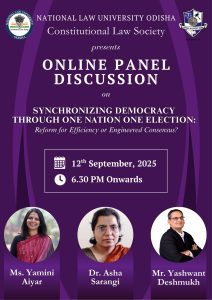
Synchronizing Democracy Through One Nation One Election: Reform for Efficiency or Engineered Consensus?”
12th September 2025
INTRODUCTION:
The One Nation, One Election Bill (ONOE), formally introduced as the 129th Constitutional Amendment Bill, 2024, represents a watershed moment in India’s electoral history. It seeks to synchronise the elections to the Lok Sabha and State Legislative Assemblies, thereby reviving a practice followed in the early years from 1951 to 1967. The initiative, endorsed by a High-Level Committee chaired by former President Ram Nath Kovind, is projected by the government to enhance administrative efficiency, reduce fiscal and environmental costs, and minimise governance disruptions caused by frequent elections. It is also expected to foster a unified national vision by aligning the country’s democratic cycles.
AIM OF THE EVENT:
The proposal has generated intense debate within legal, political, and academic circles. Former Chief Justices D.Y. Chandrachud and J.S. Khehar have affirmed its constitutional viability but has also emphasised the necessity of safeguards to prevent the concentration of “unbridled powers” in the Election Commission. While advocates highlight its potential to save billions of rupees, administrative resources, and promote stable policy cycles, critics caution that such a sweeping change may dilute regional representation, centralised political authority, and overshadow local governance issues, thereby altering the balance of India’s federal structure.
Against this backdrop, the Constitutional Law Society, NLUO, is organising a panel discussion on the theme “Synchronizing Democracy Through One Nation One Election: Reform for Efficiency or Engineered Consensus?”. The session aims to bring together eminent jurists, policymakers, and scholars to critically examine the constitutional underpinnings, logistical feasibility, and democratic safeguards surrounding ONOE. The discussion will not only consider the reform’s efficiency claims but also its potential impact on political pluralism and the voter’s democratic experience. By engaging with both the promises and perils of this electoral restructuring, the panel aims to contribute to an informed and balanced discourse on one of the most consequential constitutional reforms of our time.
ABOUT OUR PANELISTS:
Ms. Yamini Aiyar is currently a Senior Visiting Fellow, Saxena Center for Contemporary South Asia and Watson Institute, Brown University. She was the President and Chief Executive of the Centre for Policy Research, a leading multidisciplinary think tank in New Delhi from 2017-2024. Ms Aiyar’s work sits at the intersection of research and policy practice. During her tenure she spearheaded the establishment of two important new research initiatives within CPR on State capacity and Politics. Prior to becoming President, she set up the Accountability Initiative at CPR known for its work on governance, social accountability and expenditure tracking in social Policy. Her research interests span the fields of contemporary politics, state capacity, welfare policy, federalism and India’s political economy. She is also a part of a number of boards and advisory committees of research centers and non-profits such as Advisory Committee, Weatherhead Center for International Affairs, Harvard University, Member, United Nations Committee of the Experts on Public Administration and Member, Chief Minister’s Rajasthan Economic Transformation Advisory Council (2022-2023) to name a few. She has been widely published across national and international journals and is a regular columnist in the Hindustan Times and Deccan Herald.
Dr Asha Sarangi is a Professor of Political Science at the Centre for Political Studies, School of Social Sciences in Jawaharlal Nehru University, New Delhi. She did her PhD from University of Chicago, USA, where she was awarded the COSAS Fellowship for her work. She is also the recipient of the Social Scientist Award under the Indo-French Cultural Exchange Programme given by the University Grant Commission. Her areas of interest include political and cultural economy of development in modern India, identity and politics in South Asia and more specifically linguistic nationalism in modern India. She has written for several academic journals such as Taylor & Francis, EPW and the India Review. She has also authored several books on language and identity politics in India as well.
Mr Yashwant Deshmukh is a senior Journalist and Psephologist. For more than 25 years he has been inseparable part of Political and Elections coverage in Indian Media and has appeared extensively on almost all the leading News Channels including Aaj Tak, ABP, Times Now, Zee, Republic, India Today, BBC, CNN18, TV9, News24 and number of vernacular networks. He is the founder-director of C-Voter, one of the leading international Public Opinion and Stakeholder research agencies with expertise in working on assignments related to democratization, disaster mitigation and conflict resolution. A first-generation entrepreneur, he has travelled in more than 40 countries working in a number of transitional states and societies across Asia, America, Europe and Africa. Yashwant Deshmukh is an accomplished speaker, mentor, coach and trainer for media and communications students. His regular research workshops are attended by hundreds of students in many International as well as Indian universities.
The Panel Discussion shall take place on 12th September 2025, from 6:30 pm to 8:00 pm. It shall take place virtually and shall witness participation from students all over the nation.
Child Protection Mentorship Program – Inaugural Event
18th July 2025
Venue: Conference Hall, NLUO | Date: 18th July 2025 |Time: 1:30 PM onwards
The Centre for Child Rights (CCR), National Law University Odisha, in collaboration with UNICEF, is launching the Child Protection Mentorship Program through a hybrid inaugural event on 18th July 2025. This unique mentorship initiative is designed for early and mid-career professionals across Odisha working in the development and child protection sector.
The program seeks to strengthen the skills, knowledge, and leadership potential of participants to contribute effectively to safeguarding children’s rights. The event will feature thought-provoking discussions with senior dignitaries including Hon’ble Justice Murahari Sri Raman, Orissa High Court, along with experts from UNICEF, Bakul Foundation and others.
